Lyft accuses Uber employees of trying to jam its system
Gloves off in fight between Lyft and Uber
In the ridesharing rivalry between Uber and Lyft, the gloves came off with the start of 2014. But the fighting got more intense this week, with Lyft accusing Uber employees of trying to jam its computer system.
Here are the five most notable battles and attacks this year between the two rivals:
1. Lyft accuses Uber employees of denial-of-service attack
Lyft this week said its data show that at least 177 known Uber employees have opened up the Lyft app, requested a ride and subsequently canceled it as part of a strategy to jam Lyft's service and prompt customers to use Uber instead, according to CNN Money. Since October, Uber employees have done this at least 5,560 times, according to Lyft. Most recently, this kind of attack occurred during Lyft's launch in New York City, Lyft told The Times.
Uber denied the attacks and has instead accussed Lyft's employees, drivers and one of its co-founders of canceling 12,900 trips on Uber's app.
"These attacks from Lyft are unfortunate but somewhat expected," an Uber spokeswoman told The Times. "A number of Lyft investors have recently been pushing Uber to acquire Lyft. One of their largest shareholders recently warned that Lyft would 'go nuclear' if we do not acquire them."
2. Uber outfunds Lyft
This April, Lyft secured $250 million in venture capital funding, gaining resources necessary to catch up to Uber. But not one to be outdone, Uber in June announced that it had raised $1.2 billion.
3. Driver poaching
Uber has reportedly poached Lyft drivers by offering them bonuses since last year, but after securing its $250-million venture capital funding, Lyft began using similar tactics, according to Forbes. In May, Lyft rented a lot in San Francisco across the street from Uber's car inspection center and lured Uber drivers by offering them free tacos and other goodies. Both offered drivers as much as $500 to switch sides, according to the Forbes report.
4. Carpool services
Last week, the two companies created a new battle front bysimultaneously launching carpooling services. On Monday and Tuesday, Lyft contacted reporters to alert them about its service Lyft Line, which would be publicly announced the next day. But a few hours later, Uber unveiled UberPool on its online blog, beating Lyft to the punch.
5. Lyft temporarily stops taking commissions
Shortly after securing funding in April, Lyft announced that it would not take any commissions from drivers and cut fares by 10% in all its markets, undercutting Uber rates.
Uber did not respond to Lyft's move and continued to take commissions from its drivers.
This week, Lyft restored its commission but revamped it: The more hours drivers work for Lyft, the less commission they have to pay.
Follow me on Twitter for more ridesharing news: @sal19
A Lyft passenger died in a crash on a highway outside of Sacramento, Calif. early Saturday morning, an accident that will test the car-service company’s insurance policies.
The fatal accident occurred at 1:25 a.m. on westbound Interstate 80 in Citrus Heights during heavy rain, said California Highway Patrol Officer Chad Hertzell. An unknown car rear-ended a Kia and drove away, and the Kia spun out into the middle lanes and stalled.
The driver of the Lyft, a Toyota Camry, saw the stalled Kia and swerved off to the right, Hertzell told FORBES. The Lyft, which had two passengers in it, hit a tree, spun some more, and hit a second tree. The back left side of the car collided with the tree, killing the passenger sitting in the back left seat. Hertzell said the Lyft was traveling around 65 miles per hour.
The passenger was 24-year-old Shane Holland of West Sacramento, according to the Sacramento County Coroner. Holland’s father told local television station FOX40 said Holland was riding back from a Halloween party with his boyfriend.
This is the first time a Lyft passenger has died in an accident, the company said. Lyft’s insurance policies are built to protect passengers and other parties in accidents like this, but which policy depends on which party is found to be at fault.
Lyft has a $1 million liability policy, but liability policies only go into effect when the driver is found to be at fault. Otherwise, the insurance of the party that is at fault is responsible for paying.
Determining fault in this accident will be a complicated process. By the time CHP officers arrived at the crash scene, several of the parties had already left for hospitals, Hertzell said. As best they can piece together, after the Lyft swerved off the road, several more cars were involved in the pileup. A Dodge hit the Kia, and a big rig hit the Kia as well and drove off. Local television station KCRA reported that the big rig hit the Camry and drove off. Hertzell disputed that account, but if the death had been caused by a hit-and-run driver, the accident would be covered under Lyft’s $1 million uninsured/underinsured motorist policy. No parties involved in the accident have been charged.
However the accident’s fault is determined, the tragic case will test Lyft’s insurance and safety policies. Uber, a rival car-service app company, has not had a passenger die during an accident, but one of its driver hit and killed 6-year-old Sophia Liu in San Francisco in January. The driver was logged onto the app but did not have a passenger in the car at the time. After the accident, the company was pushed to increase the breadth of its insurance coverage. Uber, however, maintains it was not at fault in the accident, and the Liu family has filed a wrongful death suit against both the driver and the company.
“Our thoughts and prayers go out to the families and loved ones involved in this tragedy,” said Lyft spokeswoman Erin Simpson. “We are deeply saddened to hear this news and will continue to support those involved as well as authorities in the ongoing investigation.”
Follow me on Twitter at @ellenhuet, find more of my stories onForbes or email me at ehuet at forbes.com.
War of the Ride-Sharing Apps: Uber vs. Lyft: Forum | KQED Public Media for Northern CA: "The battle between Uber and Lyft is heating up, with both San Francisco-based ride-sharing apps accusing each other of underhanded tactics to poach drivers and nab more customers. Most recently, Lyft accused Uber employees of requesting thousands of Lyft rides and then canceling them. What does the rivalry mean for the region, and how does it affect the companies' current dispute with taxis?
With the rise of what some call the “sharing economy” — or shared access to goods, services, data and talent — many industries are facing disruption. One of those is the taxi industry, where app-based ride-service startups threaten the taxis’ entrenched business model. In the first installment of a three-part series, KQED’s Jon Brooks looks at the shakeout, assessing the risks and benefits to those who sign up as ride-service drivers vs. traditional cab drivers, and uncovers some startling signs of trouble in San Francisco.
On the streets of San Francisco, what might be called the “Mustache War” has begun, pitting the traditional taxi industry against the networked ride services like Lyft (of the pink mustache), Sidecar and UberX. In September, the California Public Utilities Commission approved regulations to oversee the ride-service startups, which allow passengers to hire private drivers through smartphone apps.
The nascent business model has been widely called “ride-sharing,” but the CPUC said that term is a misnomer. The companies are now officially referred to as “Transportation Network Companies,” or TNCs, a term with a much less altruistic ring.
Though the TNCs may have lost the connotative battle, they think they’ve won the war. While the new regulations require the companies to run background checks and institute training programs, offer a higher level of insurance and accommodate disabled passengers and low-income neighborhoods, they have also given the companies official legal sanction to operate.
That’s a far cry from a year ago, when the CPUC hit TNCs with cease-and-desist letters and fines.
If these high-tech ride-for-hire matchmakers are the big winners in the regulatory conflict, the traditional taxi industry sees itself as decidedly on the short end.
In San Francisco, while the new services have helped mitigate the notoriously difficult task of finding a cab during peak hours, they have also prompted bitter protests from licensed companies and drivers, who view them as unregulated competition that has taken a big bite out of the taxi market. Before the CPUC issued its proposal in July, hundreds of protesting drivers circled San Francisco City Hall in their taxis, honking horns and calling on Mayor Ed Lee, despite his lack of jurisdiction, to kick the companies out of San Francisco.
Cab Industry: Personal Vehicles for Hire ‘Outrageous’
Hansu Kim, the owner of San Francisco’s DeSoto Cab and a board member of the trade group Taxicab Paratransit Association of California, acknowledges the CPUC’s regulations might go some way in leveling the playing field in terms of competition between the ride services and the tightly regulated cab industry.
But he says the rules don’t go far enough to stop the bleeding in the taxi business or to protect public safety. TPAC has filed an appeal with the CPUC over its decision, and Kim says the industry will most likely sueover its declining fortunes.
“I think the industry has no choice but to monetize their losses and take it to the courts,” he says. “I’m tightly regulated — what I can charge, the number of vehicles I can put out. They can charge what they want and put out the number of vehicles they want.”
And Kim concludes: “The idea of taking a personal car and acting like a commercial vehicle for hire is outrageous.”
“This is the same service competing for the same customers,” says Barry Korengold, president of the San Francisco Cab Drivers Association. But he complains the new companies are allowed to bypass city regulations on the rates they charge, insurance, permit fees and the like.
Brad Newsham, who drove a cab in the city for 28 years and was also a chair of the United Taxicab Workers, says what’s particularly galling is the low barrier to entry for the newbies compared to what the city requires cab drivers to go through.
“They didn’t have to go to cab school, didn’t have to pay for an A-card,” Newsham says, referring to a cab-specific license that costs about $100 a year. “They didn’t have to do all the stuff we have to do. … I worked 20 years to get a medallion and these people walk in there and suddenly they’ve got everything I’ve got.”
In its rule-making, the CPUC rejected arguments charging the TNCs with unfair competition and dismissed warnings the new services will result in a “race toward the bottom with negative impact on safety and service.” In fact, the commission said its rules were similar to what the San Francisco Municipal Transportation Agency already requires of cab operators
The way Brad Newsham sees it, regulations or not, the TNCs could finish off the cab industry.
“In my estimation, it’s on the verge of being wiped out,” he says. And he thinks the Internet’s so-called “sharing economy,” allowing all sorts of people to transform themselves into instant entrepreneurs by leveraging personal assets like a car or a home, might put an end to the driving profession.
“Maybe the cab driver as an institution is dead,” he says.
That’s not the only time I heard taxi industry stakeholders describe the ride services as an existential threat.
“The cab industry will disappear,” says Barry Korengold of the cab drivers association. “There will be no cab industry if this isn’t addressed.”
Giving Them the Finger
Besides engaging in heated rhetoric, cab drivers have also taken out their frustrations on their ride-service counterparts in the street.
One of the Lyft drivers I spoke to said cab drivers have given him his “fair share of the one-finger salute.” Said another: “I have never been harassed, but I’ll admit, after reading some of the crap fellow drivers go through, I often take my mustache down when I don’t have any passengers.”
Brad Newsham, a former cab driver of 28 years who was also a chair of the United Taxicab Workers. (Courtesy David Kidd)
Another driver said that in the course of the four months he’s been working for Lyft, there have been maybe five incidents in which cab drivers have taken him on, calling him a “whore,” boxing in his vehicle, and taking a picture of his license plate, accompanied by a threat to send it to his insurance company.
That last tactic — outing ride-service drivers as commercial-vehicle operators to their insurers — is actually an official policy of the San Francisco Cab Drivers Association, says Barry Korengold. “We’re supplying [the insurance companies] with factual evidence,” he says. “We collect the license plate numbers.” He says so far, his group has logged 1,300 or 1,400 plates.
Even Newsham, an author who was once featured on NPR and comes across as relatively even-tempered, says he couldn’t control himself when it came to the pink mustaches. “I’m not a guy who flips the bird. But the last few months I was driving a cab, every time I saw one … my hand went up. I just couldn’t stop it.”
In talking to longtime cab drivers like Newsham and Korengold, I thought there might be something other than just financial self-interest involved in their extreme animosity toward ride-service drivers. I suggested to Korengold, who has been driving for 30 years, that he sounded downright “offended” by the newcomers, who have set up shop as professional drivers so quickly and with an almost total absence of bureaucratic hassle. He jumped on that word.
“I’m totally offended. It’s disrespectful to the occupation. It’s a dangerous occupation. Not only do you have to worry about unruly passengers, drunk drivers, it’s a backbreaking job. It’s very disrespectful to the people who are doing this for years and it makes a mockery of the occupation, and of the regulations.”
Cab Industry ‘Shot Itself in the Foot’
Some in the San Francisco taxi community admit the industry’s failure to solve well-known problems, like the unavailability of cabs, have given the ride services an opening. “I think it’s pretty clear that these new services popped up because the taxi industry did not provide service here,” says Hansu Kim.
“I gotta say, it’s a good thing for the people of San Francisco that they can get a cab more easily now,” says Newsham. “The one good thing about this whole thing that has happened in the past years.”
Addressing that issue in a blog post, KQED Pop’s Lizzy Acker wrote about a Lyft ride she took to the airport in August: “It’s convenient and personal and I actually got a timely, affordable ride, which no taxi company in SF seemed able to provide for me on a Thursday afternoon for any price.”
Newsham criticizes the industry for not figuring out how to offer that kind of easy access to taxis. “The cab industry here shot itself in the foot,” he says. “…It has refused to deploy dispatching innovations. It has refused to keep up with the times and the times have moved right past them.”
Newsham says cab drivers have been asking for something called “centralized dispatch” for decades.
Christiane Hayashi, the SFMTA’s director of Taxis and Accessible Services, elaborates: “I think it was initially raised in the 1980s. They said, ‘Geez – wouldn’t it be nice if you could call one number and access every taxi.’ The powers that be have resisted that for many years now.”
Why?
Hayashi says cab companies don’t want to give customers to their competitors. “To some extent it’s legitimate,” she says. “It’s an understandable response from businesses. But unfortunately it’s not serving the public.”
Hayashi says the two smartphone apps that now dispatch taxis in San Francisco, TaxiMagic and Flywheel, “only recently have signed up sufficient numbers of taxis to be really effective.” She says the SFMTA is “working as fast as we can” to expand the system.
“I believe that if we can make all taxis available through the smartphone applications then we will be able to provide the same kind of reliability and easy electronic access that has made Lyft and Sidecar attractive to consumers,” she says.
Ride-Service Drivers Dig Their Jobs
Driving a taxi has traditionally been a way to supplement an income or earn a living while avoiding the 9-to-5 world.
Newsham characterizes those who gravitate to the job as “people who don’t quite fit in regular mainstream culture. The first thing you notice is you don’t have a boss in your presence all the time, someone telling you what to do. That’s really attractive.”
Now, with the advent of TNCs, in which drivers can use their own vehicles as opposed to having to own or rent a licensed taxi, the profession is open to all comers. We spoke to seven of them — six from Lyft, one from Sidecar. They were all highly positive about their experiences, citing good money and the freedom to work whenever they want. The Lyft drivers were particularly enthusiastic about what they called “Power Hours,” peak times when they get to keep 100 percent of their earnings.
We’re not using the last names of these drivers, for reasons we’ll get to in Part 2, when we talk about the uncertainties around insurance for TNC drivers.
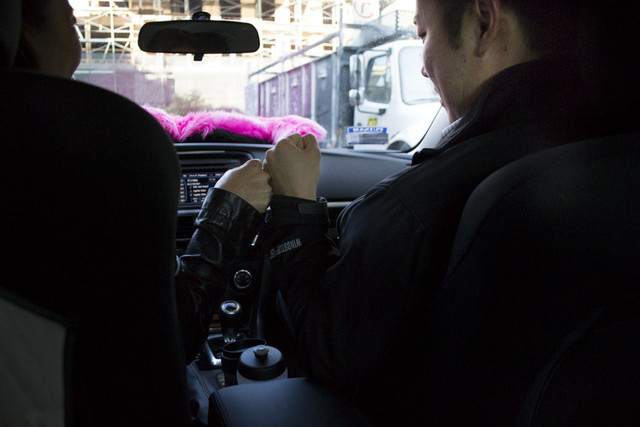
James Lee fist bumps Lyft driver Alice before she takes him to work. Lee says he uses Lyft every day and prefers its convenience and reliability to public transportation.(Sara Bloomberg/KQED)
One Lyft driver, Mike, says he makes an average of $25-$30 per hour on weekdays, $40 on weekends. “It is very lucrative,” he says. Like all the Lyft drivers we spoke to, he had no previous experience transporting customers, but really enjoys the job. “I sit out here for six to eight hours on a shift and I drive around and I talk to people and basically have fun. I learn all the new venues to go to, I hear about restaurants I’ve never tried, I meet all kinds of interesting people. I’m basically talking all night and listening to music.”
He says he’s given well over 1,000 rides since he started driving for Lyft. Any problems? “We rank all our passengers on a scale of one to five based on the experience that we have with them. … And I’ve never given anyone less than a five.”
One reason Mike might like his clientele so much: He can decline to pick up passengers based on how other drivers have rated them.
He can also bypass passengers that don’t typically tip at a certain percentage of Lyft’s suggested “donation” for each ride. That functionality helps weed out the stiffs, he says. “If you have a passenger out there that never (tips), eventually they’ll request a ride and never get one.”
Alice has been driving for Lyft since April. After seeing the company’s ad on Facebook, she filled out an online request for information, got a call and went for an interview. After a background check — “to make sure you’re a normal human being” — she was approved.
She says she was then given a one-hour orientation, and that was that — she was up and running as a professional driver. (Lyft has recently become more stringent about whom they take on, instituting a mentor system in which experienced drivers assess prospective candidates and make recommendations as to their hire. And per CPUC regulations, all TNCs will have to start training programs.)
Alice says she works about 20 hours per week and makes $25-$35 per hour, depending on the time of day she goes out. After 1,200 rides, she’s a big fan of Lyft, her fellow drivers, the passengers — everything. “Lyft is a great, positive community made up of a lot of good-hearted people,” she says.
Dan says he’s been a Lyft driver since April, and his boyfriend also goes out on calls. He has a full-time job as a teacher and doesn’t want to be held down to another commitment, which makes ride-service work attractive.
“If I have some spare time, I’ll log into the app and get some hours,” he says. “I can start driving on a whim.” Dan reports he makes anywhere from $22 to $35 an hour over the course of a four-hour shift.
Jason is 26 and says he’s been driving for Lyft for four months. He was unemployed when he saw the company’s Facebook ad and signed up. He is pretty much working full time and estimates his earnings at $30-$35 per hour. He loves the job: “I think it’s really fun, I meet a whole bunch of people and have great conversations every day.”
One driver, who didn’t want us to use even his first name, says he was one of Lyft’s first 50 drivers, starting back when the company paid a flat rate of $18 per hour. He makes more than that now, no less than $25 an hour during a slow shift and always more than $30 on the weekend. He has another business, but it’s not going well, and Lyft is now his main source of income.
He’s fiercely pro-Lyft: “For me, Lyft is a company that’s really good. They take care of their employees and their passengers. It is kind of a community.”
I ask if it bothers him that he works 30 to 40 hours a week but gets no health care, workers’ comp or other benefits. (Lyft and Uber have both been named in lawsuits that allege the companies incorrectly classify workers as independent contractors.)
“We’re hoping there will be something like that in the future,” he says.
(Except for workers’ comp, cab drivers are in the same boat. When I asked Brad Newsham if taxi drivers get benefits like health care and vacation time, his answer was, “Ha ha ha ha ha.”)
A driver for Sidecar, Jeremy, has been on the job since last Christmas. He says he makes an average of $30 an hour, driving 20-25 hours per week. He is also a big fan of this gig. “I just had my 1,000th ride this year and I love it,” he says. “I meet really nice people; most of them are from the tech industry, I believe, from talking to them.”
It’s not surprising that these newbies to the business are excited about their jobs, Newsham says. “I loved cab driving from the first day, period,” he said. “Driving around the world’s prettiest city, talking to people. … Every day, even after 28 years, I saw something new, something that took my breath away. And in the beginning it was more money than I had ever made in my life. I just fell in love with it.”
But for those TNC drivers who are thinking of permanently strapping on the ‘stache, Newsham has a warning: This is the honeymoon period. Driving year in and year out takes its toll. “I worked a year-and-a-half in an underground mine. That was hard labor. I put cab driving right up there with it.” Newsham says being wary of “not killing somebody, not killing yourself,” while also trying to make enough to pay the rent is extremely stressful.
Taxi Drivers See Income Decline
That last part — paying the rent — explains why taxi drivers are so worried about the TNCs. Because if ride-service drivers express an almost universal sense of happiness about the money they can make, that is coming at the expense of the traditional taxi business.
John Han, who’s been driving a cab for 11 years, says he currently makes between $20-$35 per hour, but that pay can vary widely from driver to driver. He says one driver he recently spoke to, someone whose English wasn’t great, told him that after gas and gate fees, he took home $10 totalover a Saturday and Sunday.
Han says that, anecdotally at least, $15-$19 per hour is more the norm for taxi drivers now. And that pay rate is going down, according to drivers who say they’ve taken a sharp financial hit since the surfeit of new vehicles-for-hire has hit the road.
Ed Healy has been driving a cab for 30 years, and he blogs about the industry and his contempt for the ride services at The Phantom Cab Driver Phites Back. Healy estimates taxi driver earnings are off about 25 percent as a result of all the additional competition.
Newsham says he’s heard that figure from other drivers, too. Hansu Kim, owner of San Francisco’s DeSoto Cab, puts the drop in all taxi business citywide in the same range — anywhere from 25 to 33 percent in the past year.
Newsham says the “bandit cabs,” as he calls them, were the final straw in his own decision to quit the business this year. In his best years as a driver, he made $30,000 to $35,000 a year driving 20 to 30 hours a week. By the time he pocketed his last tip, he was making next to nothing — about $5 an hour — which he attributes to all the new competition. That big drop in income prompted him to sell his medallion, the permit that allows cab owners to lease out their vehicles to drivers and companies. The sale netted him $150,000.
“Seems like there was no choice. I had to take that 150K while it was still there,” he says, referring to the declining value of taxi ownership.
Some Passengers ‘Have Sworn Off Cabs Forever’
I asked some of the ride-service drivers if they felt bad about the financial blow cab drivers have absorbed.
Not really, says Alice. So many of her passengers are using Lyft because they cannot get a taxi to take them to the outer areas of the city.
“Most of my passengers say they cannot get a cab ride to the Outer Sunset,” she says.
“People [tell me] they’ve gotten kicked out of cabs, the driver says ‘No, I’m about to go home so get out of my car,’ or they say, ‘My tire’s flat, I can’t drive that way now.’ I’ve heard many, many cab horror stories about how they cannot get a cab. So it’s hard for me to feel sympathy for an industry that is still excluding a lot of passengers. Most of Lyft’s passengers have sworn off cabs forever.”
TNC drivers say their passengers have sworn off cabs forever. (Deborah Svoboda/KQED)
DeSoto Cab’s Hansu Kim responds that, “That’s happened on occasion, but it’s really not that common now.” The SFMTA’s Christiane Hayashi says the agency has adopted regulations requiring dispatch permit holders to meet minimum requirements to “increase responsiveness to neighborhood dispatch requests,” and that any company that fails to comply with those standards will be shut down.
Lyft driver Mike says he is sympathetic to cab drivers, but doesn’t appreciate all the flak coming his way.
“There’s some great cab drivers out there that are suffering from this, and I really hope that can come to a better place for them,” he says. “And for the drivers that are out there bad-mouthing us, find out the truth. They’re all out there saying we’re all uninsured and this, that and the other, and we’re horrible people and we don’t go through any training. I just tell people to do a little research before you believe everything that you read.”
Brad Newsham says that while he understands the appeal of the new services, and that passengers are frustrated with the taxi industry, there is still a real human cost to the dislocation that is occurring.
“Nobody knows who these people are, the cab drivers who are getting the shaft here,” he says. “Nobody knows their stories. Nobody knows what they’ve been through. If you’re coming in here and you’re all gaga about your new job, you don’t know whose career you’ve just put a bullet through the head of. You get all caught up in the technology. Technology is hip, technology is cool, tech is the future. (But) what about the people?”
Wanna Drive a Cab? ‘Not Even.’
I asked some of our ride-service drivers if they’d ever thought of driving a cab, which would entail a much more involved process than signing up for ride-service work.
“Not even,” said one, which seemed to sum up the attitude of the group.
OK, but what about the reverse? If things are so bad in the cab industry, why don’t more cab drivers, instead of protesting, make the switch to ride-service gigs?
Well, they are, actually, says DeSoto Cab’s Kim.
“My biggest concern is the shortage of (cab) drivers. A lot of the drivers are leaving the business. There’s no doubt some drivers have decided to do it on their own.”
John Han, who drives for Yellow Cab, says he thinks cab companies are having a hard time filling shifts, and that a dispatcher recently told him he could work extra days without having to go through the company’s lottery system. Han says he thinks “a fair share of taxi drivers have moved to Lyft, Sidecar and UberX.”
But some longtime taxi drivers who know the business inside and out think there is a serious risk that the ride-service drivers are overlooking. “I wouldn’t ever drive in one because of the insurance issue,” said Ed Healy. “I actually signed up at (Lyft and Sidecar) … but I decided not to drive the cars after I read the terms and conditions of the contract, because I wasn’t going to leave my car exposed to an accident.”
We’ll take a closer look at the insurance issues in Part Two of our series next week.